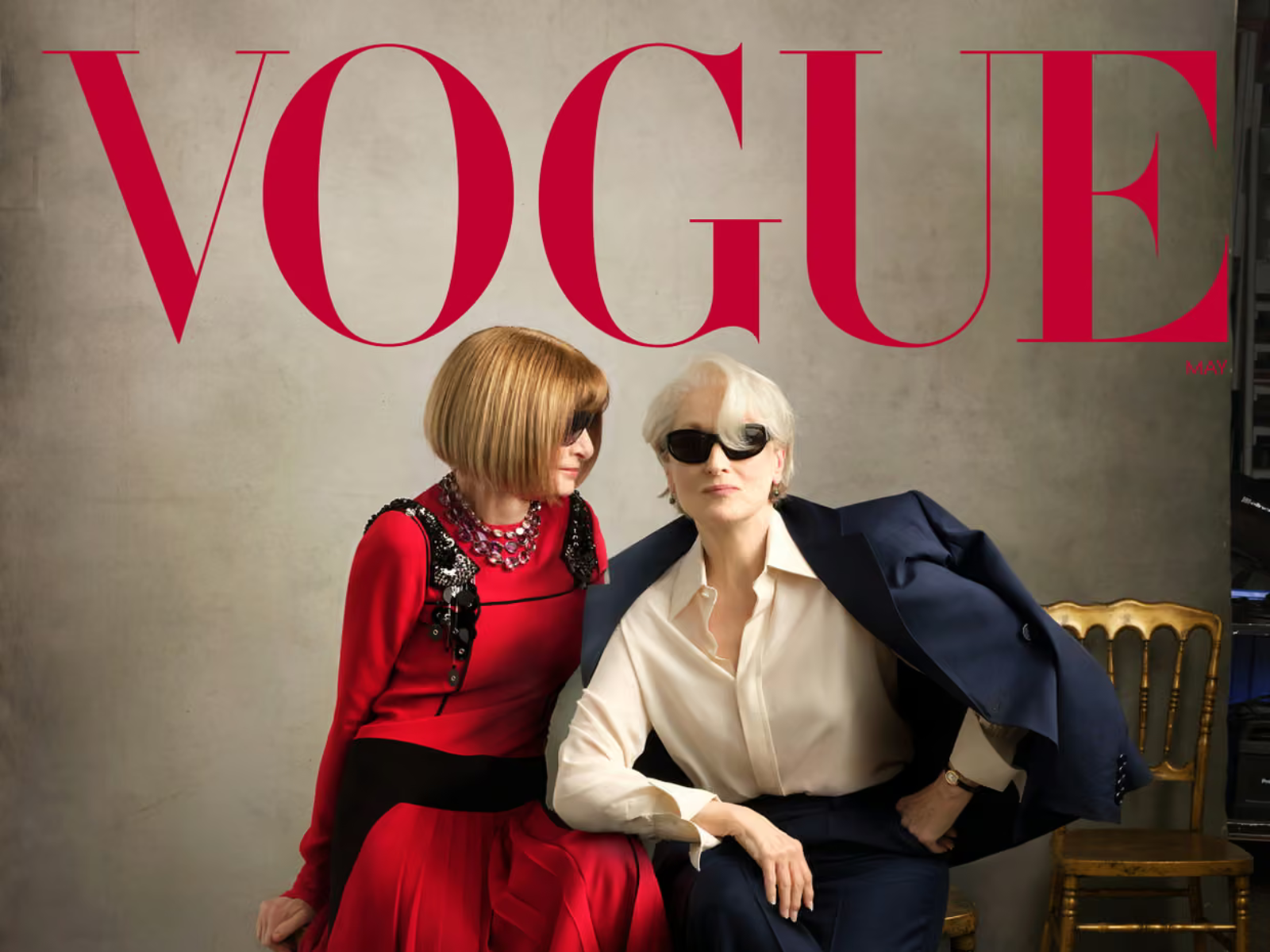
What Vogue’s May cover reveals about authority, identity and cultural power.
Anna Wintour has appeared on the May cover of Vogue for the first time in her 38 years at the publication. She shares the cover with Meryl Streep - the actor who portrays her in The Devil Wears Prada. On the surface, the two cover stars symbolise fashion mythology meeting Hollywood legend: the real Miranda Priestly, and the character who plays her. Beneath this, is a more important signal about power and the rise of human authority.
“The cover reflects a shift towards recognising humans over institutions, and identity over corporate positioning.”
Observation
Vogue represents institutional authority in fashion. Anna Wintour shaped the publication’s influence, visibility and cultural positioning - while becoming one of the most recognisable identities in media through her iconic image.
The release of The Devil Wears Prada in 2006 transformed her from an industry power figure into a known cultural character. That mythology was reinforced by The September Issue documentary in 2009, and following that The Met Gala from 2010 onwards - which became a worldwide attention event, where Wintour became a visible gatekeeper of access and legitimacy. Over time, she has become a brand herself.
Yet, despite this visibility, until now, she remained behind the masthead. Editors-in-chief do not traditionally appear on the covers of their own magazines, making this cover a notable shift in publishing history.
Interpretation
This Vogue cover acknowledges something that had already happened culturally. Anna Wintour stopped being the editor of Vogue years ago, and became a globally recognisable symbol of its authority and institutional power herself. The editor has become the story.
The pairing with Meryl Streep marries reality and mythology. It acknowledges that the fictional version of Wintour has become so culturally powerful that it escaped the institution itself. The cover quietly signals that her cultural value now travels independently from the publication she helped build - reflecting a shift towards recognising humans over institutions, and identity over corporate positioning.
In the past, institutions created legitimacy for individuals. Increasingly, individuals create legitimacy for institutions.
The same pattern appears across industries:Apple became inseparable from Steve Jobs, Tesla and SpaceX operate through the visibility of Elon Musk, Phoebe Philo’s influence stretched beyond Céline, and Oprah became the institution itself.
Human authority feels more trusted, relatable, memorable and relevant than institutional messaging. Identity itself is infrastructure.
The Final Word
The strongest brands will not just be recognised for their products, services or experiences, but for the people attached to them. As institutions become less emotionally resonant, recognisable individuals who take a stand become stronger sources of meaning and relevance. The Vogue cover signals something subtle but clear: Sometimes, the institution is no longer the asset - the person is.
There is also risk in this shift, something luxury fashion houses understand well through the influence of creative directors. When authority concentrates too heavily around individuals, institutions can weaken underneath them. Succession becomes harder, and brands become dependent on personalities. Potentially, the stronger the character, the more fragile the institution becomes without them.
Alternatively?
Focus less on building personalities, amd more on making the clients the identity itself. Build an institution with a community so powerful it becomes your product - because people no longer buy brands, they join them.
Read next: Zara x Bad Bunny. The moment mattered more than the marketing.
Email subscribers receive exclusive perspectives - sign up here.