Signals & Moves
Bots, Bottles and Banknotes.
Wednesday 29 July
1
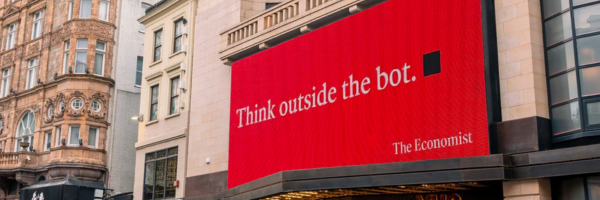
Move: The Economist launches a billboard campaign defending human judgement.
The Economist has released a series of its iconic red and white outdoor ads across London and New York with lines including: “Think outside the bot”, “Authentic Intelligence” and “Pre-empt the prompt”.
Signal: The threat may change, but the product doesn’t.
The Economist has sold the same promise since its founding in 1843 against a changing cast of enemies; first ignorance, then fake news, now AI. Its position has remained the same: we decide what matters, so you don’t have to. The Economist has never sold news, it sells judgement.
Is “Made By Human” the next hallmark of quality?
We already pay more for artisan products because we value the person behind them. As AI becomes the norm, brands built on craft, creativity or curation may find that prioritising human judgement is not a defensive position, but a desirable one.
2
Move: Shadows complete a giant Corona bottle at sunset.
Corona drew a chalk outline on a Cape Town pavement that becomes a complete beer bottle for a few minutes each evening, when the setting sun casts its shadows in exactly the right place.
Signal: It’s not advertising when it belongs there.
Most advertising is placed in a location, Corona built this advert from one. It doesn’t interrupt its environment; it depends on it. Only Corona could have made it feel this natural. It has spent so long owning the sunset that the moment has become a brand asset. A Corona bottle appearing at this moment is not a creative execution, it simply belongs there.
Could Heineken have done it?
Heineken has not spent years telling you that sunset is when the work stops and beer starts. Its positioning has always been more about who you are drinking with, not when. Heineken could copy the execution, but it would be borrowing a sunset. Corona already owns it.
3
Move: Europe opens a vote for its next banknote.
The European Central Bank (ECB) unveiled ten designs for future euro banknotes and invited Europeans to choose their favourite. The designs were split between European Culture and Rivers and Birds. Social media responded with thousands of memes, attracting millions of views.
Signal: The internet didn’t vote, it reviewed.
Beethoven vs birds was never going to be the story. The moment the vote opened, people used it to judge the institution, not the artwork. A note that featured the EU’s tethered bottle cap wasn’t about currency; it was about European regulation. The ECB asked for a favourite, and it received a scorecard.
What were people really voting on?
Not just the banknote. This became an honest sentiment audit on the EU. Public participation reveals what people really think, and the memes were the feedback. A vote measures preference, the conversations around it measure frustration.
Help House of Client grow by forwarding this email to one person today.
Noorin
Image reference: The Economist.
Sources: Creative Review, Creative Bloq, JCDecaux UK, B&T, Campaign, The Stable, Creative Review, Famous Campaigns, Famous Campaigns, Adweek, Famous Campaigns, Marketing Dive, MarketingWeek, Smithsonian, Designboom, Fast Company, Deutsche Bundesbank